
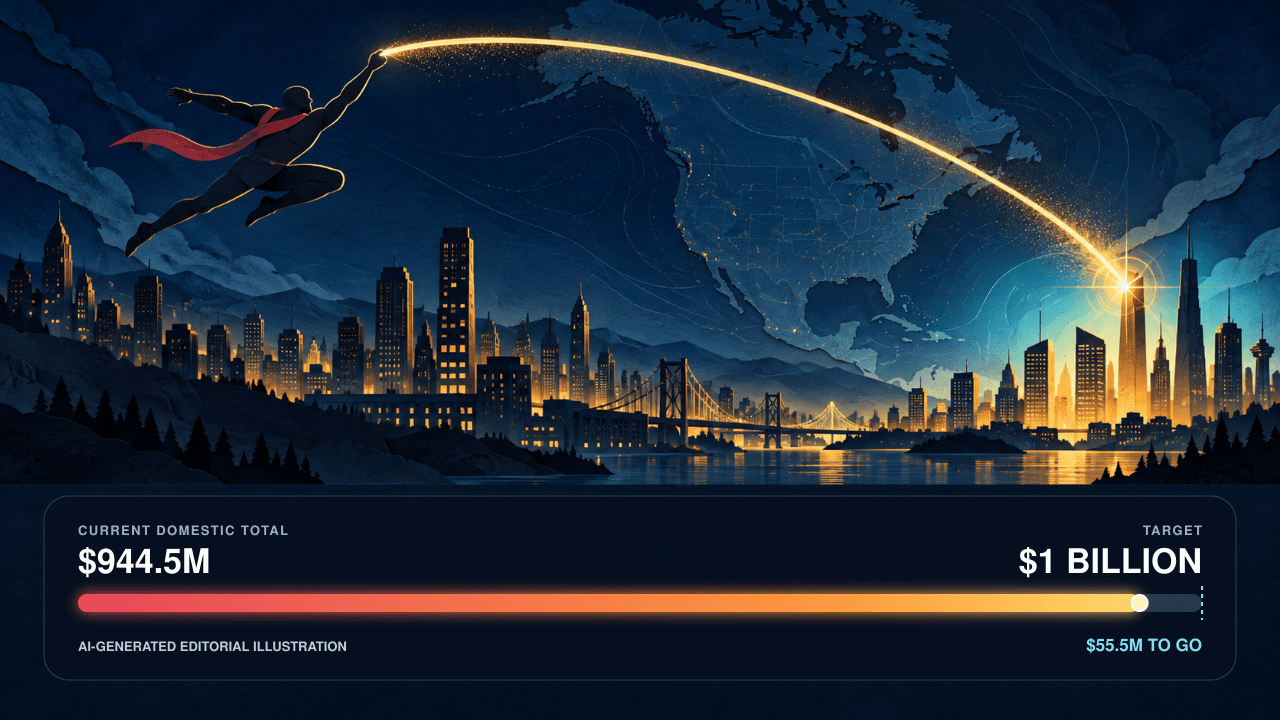
Spider-Man: Brand New Day is officially the highest-grossing movie in domestic box-office history—but becoming the first film to reach $1 billion in the United States and Canada is a much more difficult challenge.
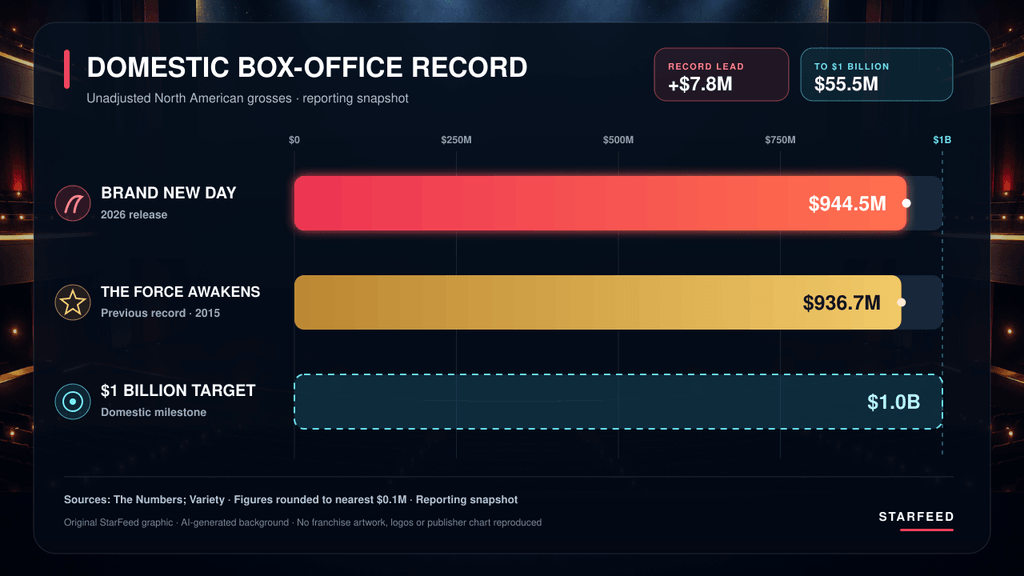
Tom Holland’s fourth solo Spider-Man movie has earned an estimated $944.5 million domestically through September 20. That places it comfortably ahead of the $936.7 million collected by Star Wars: The Force Awakens, which had held the unadjusted domestic record since 2016.
The film is now approximately $55.5 million away from the unprecedented $1 billion domestic milestone. Based on its current weekly earnings, reaching that target during its original theatrical run appears unlikely without an unusually long run, a significant promotional boost or a later rerelease.


Spider-Man Has Already Taken the Domestic Crown

Brand New Day passed The Force Awakens after 47 days in theaters, when Sony reported a domestic total of $936.773 million.
Its lead has continued to grow. The movie earned another estimated $6.5 million from September 18 through September 20, taking its North American total to $944.5 million. It finished third for the weekend behind Resident Evil and Practical Magic 2.
The movie’s domestic performance began with a record $360.1 million opening weekend, narrowly surpassing the unadjusted $357.1 million debut of Avengers: Endgame. It then remained at No. 1 for six consecutive weekends.
Lucasfilm publicly congratulated Holland, director Destin Daniel Cretton, Sony Pictures and Marvel Studios after Spider-Man took the record from Star Wars.
The $1 Billion Question Is Domestic, Not Worldwide
There is an important distinction behind the latest milestone: Brand New Day crossed $1 billion worldwide during its first week in theaters.
As of September 20, it had earned approximately $2.479 billion globally—$944.5 million domestically and $1.534 billion from international markets. That makes it the third-highest-grossing movie worldwide, behind Avatar and Avengers: Endgame.
The new question is whether a single movie can generate $1 billion from U.S. and Canadian theaters alone. No film has previously reached that mark in unadjusted dollars.
To do so, Brand New Day must collect another $55.5 million domestically. That gap is nearly nine times the movie’s most recent weekend gross.
Why Reaching $1 Billion Will Be Difficult

The movie remains widely available, playing in approximately 3,017 theaters during its eighth weekend. Its $6.5 million weekend was also a relatively encouraging decline of 23% from the previous frame.
However, a movie’s late theatrical run normally produces progressively smaller returns as new releases take screens and premium-format showings. Brand New Day has already fallen from $18.2 million during its sixth weekend to $8.4 million in its seventh and $6.5 million in its eighth.
Even if it continues posting better-than-average holds, its present trajectory points more naturally toward a final domestic total in the $960 million to $975 million range. That is an informed projection based on its declining weekly grosses, not an official studio forecast.
Sony Pictures chairman Tom Rothman declined to predict that the film would reach $1 billion when asked about the possibility. Trade reporting has similarly suggested that the target may be beyond the movie’s current run unless Sony returns it to theaters later.
A Rerelease Could Change the Calculation
Sony has several potential ways to extend the movie’s box-office life.
The studio could introduce an expanded edition, add a preview connected to a future Marvel release or organize a major rerelease before the film leaves theaters permanently. Similar strategies have previously helped movies add revenue after their initial momentum had slowed.
There is currently no confirmed rerelease designed to carry Brand New Day across $1 billion. Until Sony announces one, ticket sales from the existing theatrical version remain the only reliable measure.
The film would still need considerably more than a symbolic return to cinemas. A limited event generating only a few million dollars would leave it short, while a wide rerelease with premium screens and new material could make the milestone realistic.
The Record Comes With an Inflation Warning
Calling Brand New Day the biggest domestic movie ever refers to box-office revenue without adjusting for changing ticket prices.
Older movies sold tickets at substantially lower prices and often remained in theaters—or returned through rereleases—for years. When estimated admissions or inflation are considered, films such as Gone With the Wind remain ahead.
That qualification does not diminish Sony’s achievement. Surpassing The Force Awakens in current dollars required exceptional repeat business, broad international interest and a launch powerful enough to overcome continued concerns about superhero fatigue.

Tom Holland Has Already Made Box-Office History
Whether the film stops around $965 million or eventually reaches $1 billion, Holland’s latest Spider-Man adventure has already achieved the industry’s most closely watched domestic milestone.
It owns the unadjusted domestic opening-weekend record, the unadjusted domestic lifetime record and Sony’s worldwide box-office record. Sony also credits the movie with helping deliver one of Hollywood’s strongest post-pandemic theatrical summers.
The $1 billion target is therefore less a test of whether Brand New Day succeeded—it has succeeded beyond any reasonable expectation—than a question of how aggressively Sony wants to pursue one final number.
Without a rerelease, the movie will probably finish short. With the right theatrical event, Tom Holland could still become the first star to lead a movie past $1 billion domestically.